
Whether you load files from users’ OneDrive or from document libraries in SharePoint Online sites and groups, sapio365 retrieves the same information and provides the same document-management interface.
The difference is in how shared files are identified: OneDrive shared files are identified immediately, whereas for files in groups, Teams, and SharePoint sites, you must load permissions to determine whether a file is shared.
Keep scrolling to learn about the numbered ribbon sections shown in the image below and their features.
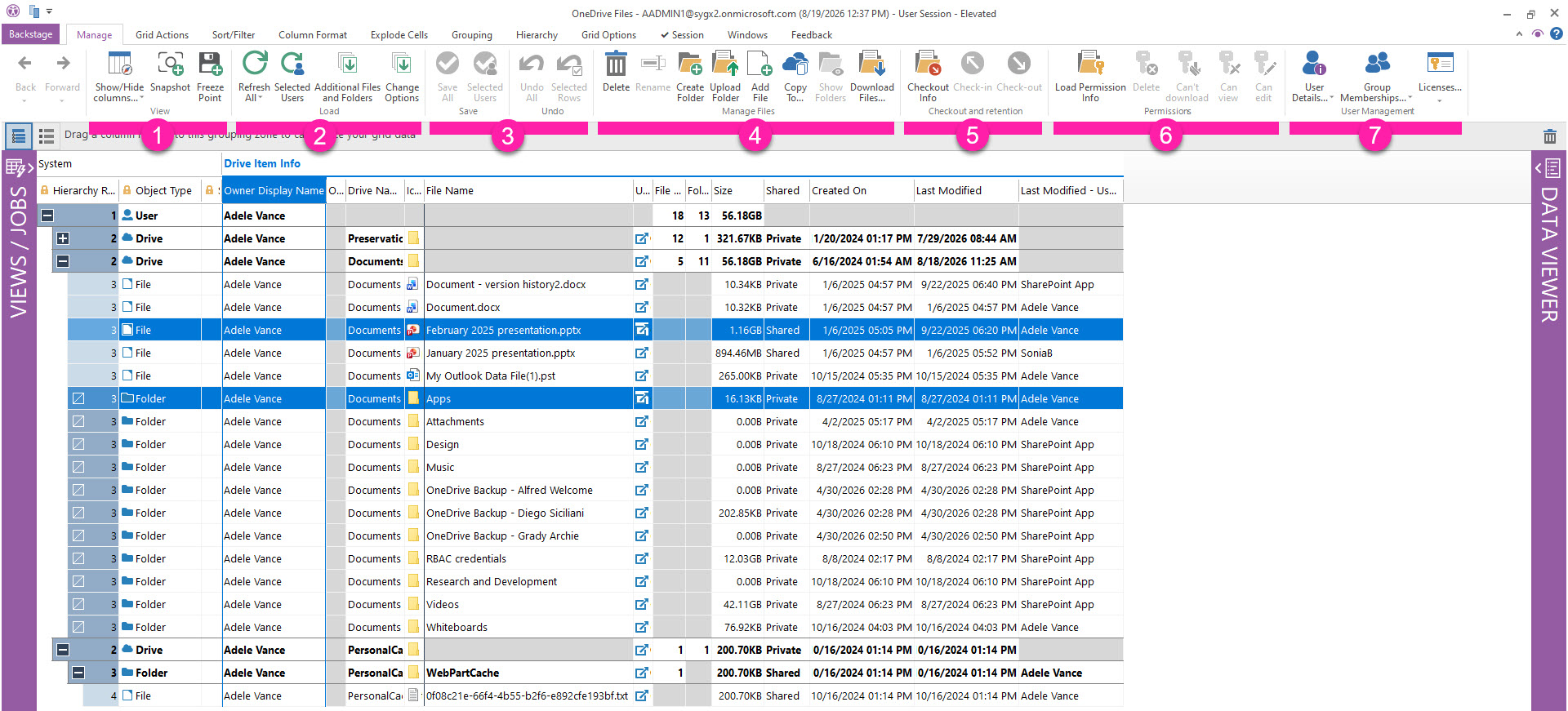
1 - View
Use this section to manage the grid layout, create shareable snapshots of the current data set, and save a recoverable working state, including grid settings such as filters and sorting, so you can continue later.

|
Button |
Description |
|---|---|
|
Show/Hide Columns |
An overview of your current column setup (or all possible columns).
|
|
Snapshot |
Save your current data set as a file. It can be shared and read by others, but will not all modifications to be saved to the server. You can also set a password and access restrictions for this file. |
|
Freeze Point |
Pause and save your work so you can resume where you left off.
|

2 - Load
Use this section to refresh grid data, load additional files and folders for selected items, and modify loading options such as drive scope, folder depth, file extensions, and search criteria.

|
Button |
Description |
|---|---|
|
Refresh All |
Refresh All Grid Data (Ctrl+R)
|
|
(Refresh) Selected (Users, Sites, Groups, Channels) |
This will refresh the data in the grid for all currently selected users, groups, sites, or channels. |
|
Additional Files and Folders |
Load more items from selected folders and notebooks you first loaded at the top level. Choose whether to load only their first-level items or the entire folder tree. Shortcut: Double-click to load the next level of files and folders To load only the next-level items in a folder, double-click the folder in the Hierarchy column. This shortcut is available only for folders that are not empty, meaning their size is greater than 0 bytes. 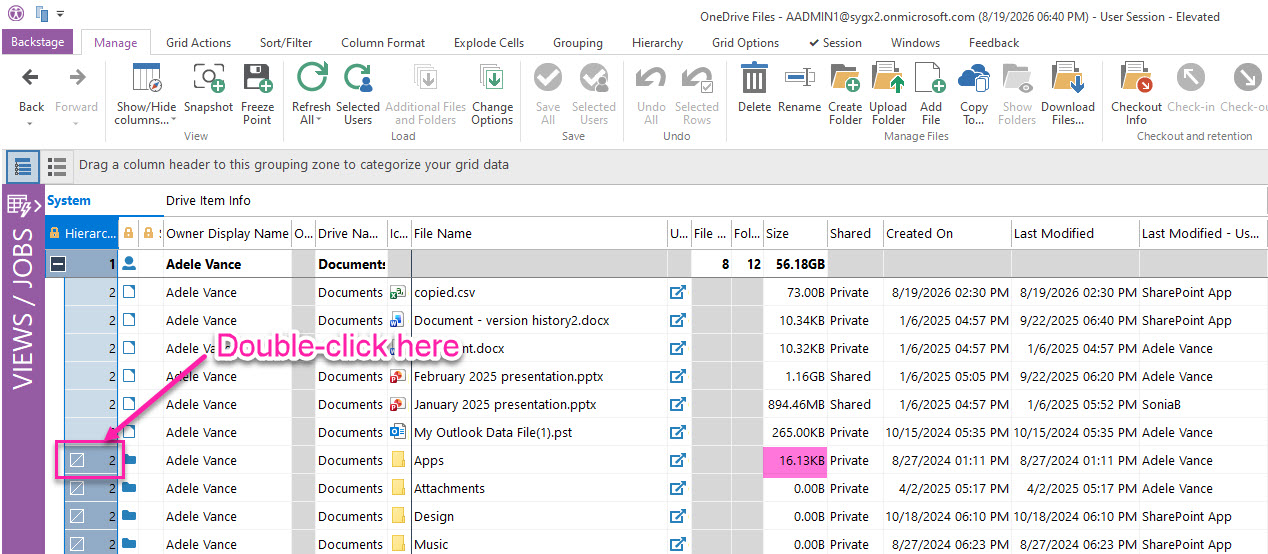
|
|
Change Options |
Load all drives or only the main ones, load only root files or the whole file trees, adjust extension filter or search criteria. |
3 - Save & Undo
Use this section to save the changes previewed in the grid or to undo unsaved changes and restore the original values.
The Undo buttons will NOT undo changes that have been saved to the server.
Tip: Grouping by the status column is a quick way to check for all pending changes.

|
Button |
Description |
|---|---|
|
Save All (Ctrl+S) |
Save your changes to the server. Any pending changes such as edited or deleted items will be indicated in the status column. |
|
(Save) Selected (Users, Sites, Groups, Channels) |
This will save all changes made for all currently selected users, groups, sites or channels. |
|
Undo All |
Undo all changes currently pending in the grid. |
|
(Undo) Selected Rows |
Undo any selected changes currently pending in the grid. |
4 - Manage Files & Folders

|
Button |
Description |
|---|---|
|
Delete |
Delete selected entries from the server. To delete a non-empty folder and its contents, you must load the full hierarchy of that folder. |
|
Rename (F2) |
Edit the name of the file or folder in the document library. This button is enabled when there is only one selected row. |
|
Create Folder |
Create a new folder in the document library. For multiple selections across folders and sites, sapio365 creates a folder with the same name in each selected location. If a folder with that name already exists at the same level, sapio365 adds a number in parentheses to the end of the folder name. |
|
Upload Folder |
Upload a folder from your computer to the document library.
|
|
Add File |
Add a new file to the selected document library. For multiple selections across folders and sites, sapio365 uploads the file to each selected location. If a file with that name already exists at the same level, you’ll be asked if you want to replace it or rename it (sapio365 will add a number in parentheses to the end of the file name). |
|
Copy selected items to another folder in OneDrive, a SharePoint site library or Teams channel. You’ll have the option to:
|
|
|
Show Folders… |
Toggle the display of folders and notebooks (hidden by default). Only available in flat view (Ctrl+F11). |
|
Download Files… |
Download the selected files from the document library and save them to a destination folder of your choice on your computer. You’ll have the option to:
|
5 - Checkout and retention
This section allows you to Check files in or out, or see applied retention labels.
Select documents and use the 'Load Checkout Info' button to load information pertaining to their checkout status and to see if there are retention labels that have been applied.
When the information has been loaded for selected documents, you can check them out to lock users from making changes to the files. You can check them back in to enable users to edit those documents.

|
Button |
Description |
|---|---|
|
Checkout Info |
Load Checkout and Retention Info to show which files are checked out and by whom, and if any retention labels are applied. |
|
Check-in |
Check-in selected files by discarding the check-out. The files will become available for co-authoring. |
|
Check-out |
Check-out selected files to ensure that no one else can edit them. |
6 - Permissions
Use this section to view and manage sharing permissions for files and folders. Load permissions for selected items to see who has access and the type of access granted, then change or remove the permissions you select.
See detailed instructions for managing file and folder permissions.
Note that sharing links like 'Anonymous' or 'Internal' cannot be updated. They can only be deleted.
For OneDrive files, only 'Shared' files from your current grid selection will be processed. Private (unshared) files will be skipped.

|
Button |
Description |
|---|---|
|
Load Permission Info (Ctrl+L) |
Display a list of all permissions for the selected items.
Loading options include:
|
|
Delete (permissions) |
Delete selected file permissions.
|
|
Can’t download |
Set the role of selected permissions to ‘Can view, but not download’ (restrictedView). |
|
Can view |
Set the role of selected permissions to ‘Can’t make changes’ (read). |
|
Can edit |
Set the role of selected permissions to ‘Make any changes’ (write). |
7 - User Management (OneDrive only)
Use this section to retrieve additional details about selected OneDrive owners, including their group memberships and assigned Microsoft 365 licenses.

|
Button |
Description |
|---|---|
|
User Details… |
Show detailed info for the selected users. |
|
Group Memberships… |
Show all group memberships for all selected users.
|
|
Licenses… |
Show a detailed list of license and service plan information, including provisioning status, for all selected users. |