Save time with sapio365 automated Jobs
sapio365 jobs are automated workflows built using sapio365 features, designed to run specific admin tasks for you with minimal manual effort. These include jobs created by the sapio365 team for common scenarios: some are report-only jobs, while others also perform actions that update or change data.
Only jobs available in the main sapio365 window can be scheduled to run automatically. You can quickly see the type of each job by checking the icon next to its name in the job list.
Expand to see the latest list of available jobs
Run or schedule the jobs below.
When you run or schedule a job, sapio365 always presents you with options first and gives you the opportunity to cancel before proceeding.
However, some jobs may begin an initial processing step before the options dialog appears, in order to gather the information needed for those options.
|
Action |
Title |
Description |
|---|---|---|
|
🖊️ Cache |
Update cache of Users, Groups and Sites |
Update the local cache of the Users, Groups and Sites modules. You can choose which information you wish to update for each. |
|
|
Find users with external email forwarding inbox rules |
List users and their inbox rules forwarding mail to external addresses. |
|
🖊️ Users |
Disable users with outdated sign-ins |
This job reviews each user’s last sign-in date and, if applicable, their last on-premises logon date based on the number of days you specify. You can choose to disable these accounts either in the cloud or on-premises. For on-premises environments, you can also move the affected accounts to another organizational unit (OU). |
|
🖊️ PowerShell |
Execute a PowerShell command |
Execute any PowerShell script using your current session. |
|
|
License Consumption Analysis |
Load Usage Reports to analyze user license consumption, and report on any licensed users who have been inactive for a chosen time period. |
|
🖊️ Cache |
Update the local cache of the Users modules. You can choose which information you wish to update for each. |
|
|
🖊️ Cache |
Update cache of Groups |
Update the local cache of the Groups modules. You can choose which information you wish to update for each. |
|
🖊️ Cache |
Update cache of Sites |
Update the local cache of the Sites modules. You can choose which information you wish to update for each. |
|
|
Global License Analysis |
This job will provide a global report of the licenses for a selection of Tenants. |
|
|
Client Secrets and Certificates Expiration report |
Get expired or about to expire Client Secrets and/or Certificates within all your Registered Applications. |
|
|
MultiTenant Applications without Verified Publisher |
Find all multitenant Registered Applications that does NOT have a Verified Publisher set. When this is the case, it may restrict the ability to users to provide consent on such applications. |
|
🖊️ Emailing |
Email owners of inactive Teams |
This job finds Teams without any activity during a period and sends a notification email to each owner. |
|
|
Group-Based Licensing Analysis |
This Job will filter and tag users that have group-based licenses and licenses assigned directly. And it will tag any user with duplicate licenses assigned. |
|
|
Chart admin roles by user count |
Create a chart of user count based on the assigned administration role. |
|
|
Chart of global license consumption |
Show chart of global license consumption. |
|
|
Get Date of Last Email Sent and/or Received |
Get the date of the last email sent and/or received for all users or a saved selection of users. |
|
|
List users with & without recent sign-in activity |
List users sign-ins activity for a specific period in the last 30 days. |
|
|
Find users unable to use Teams |
List users for whom sign-in is blocked, no Teams license is assigned, or their Teams service is disabled. |
|
|
Users with duplicate files |
List users who have duplicate OneDrive files. |
|
|
Users with duplicate plans |
List users with licenses that have overlapping service plans. |
|
|
Users with empty OneDrive accounts |
List all users without any documents in their OneDrive. |
|
|
Users with no calendar events |
List all users without calendar events. |
|
🖊️ Users |
Remove all licenses from users with blocked sign-ins |
List assigned licenses of users whose sign-in is blocked and choose to remove their licenses. If licenses are assigned via a group, users will be also removed from those groups. |
|
|
Groups with duplicate files |
List groups that have duplicate files. |
|
|
Groups with empty document library |
List groups/Teams that have a document library with no documents. |
|
🖊️ Teams |
Clean up Teams with guest members |
List Teams with guests and Teams where guests can be added, with options to change this group setting and to remove guests from those Teams. |
|
|
Find Teams where members can add, edit or delete channels |
List Teams with member settings enabled to add, edit or delete channels. |
|
|
Groups with guest members |
List groups/Teams with members who are guests (external). |
|
|
Groups with no calendar events |
List all groups/Teams without any calendar events. |
|
|
Find the last time groups were emailed |
Search members' mailboxes to find the last time selected groups were sent an email. Select groups from distribution groups, Teams, Microsoft 365 groups or email-enabled security groups. |
|
|
List recently created Teams by department |
List the Teams that were created since the date you specify and categorize them by the department of the user who created it. |
|
|
SharePoint sites without any files |
List SharePoint sites whose document library does not contain any files. |
|
|
View owned Teams for selected users |
Identify and list Teams owned for each user you select. |
|
|
Sites with duplicate files |
List sites that have duplicate files in their document library. |
|
|
View Teams of selected users |
List all the Teams each selected user belongs to. |
|
|
Find site document library files shared with many |
Search all SharePoint sites and list files that have been shared with more than a specified number of people. |
|
|
View all SharePoint sites & subsites by type (Teams, Viva Engage, private channels, etc) |
Get a clearer view of your SharePoint site topology. See which sites belong to Teams, private channels, regular Microsoft 365 groups or Viva Engage-linked groups. |
|
|
Find site files shared with guests |
Search SharePoint site document libraries and list files shared with guests. |
|
|
Trace email using subject, sender and recipient info |
Search all mailboxes for a string in the name of the sender, recipent or subject in the latest messages. |
|
🖊️ eDiscovery |
Manage existing eDiscovery Content Search |
This Job will list existing eDiscovery Content Searches, allowing you to review them and also execute them. |
|
🖊️ Groups |
Add non-member owners as members for selected groups or Teams |
Ensure the current owners of the groups or Teams you select are also members (for access to all Microsoft services). If they are not already members, they will be added to the groups or Teams they own. Applicable group types: Microsoft 365 groups or security groups. |
|
🖊️ Groups |
Add selected users as owners to all groups |
Add selected users as owners to ALL the groups in your tenant. Applicable groups types: Teams, Microsoft 365 groups or security groups. |
|
🖊️ Teams |
Archive selected Teams or Teams matching... |
This job will archive Teams you select or Teams matching "start with" or "equals to" criteria (name or email). You have the option to render the Team sites read-only for team members. |
|
|
Compare Groups Members |
Compare Groups members with a group set as reference |
|
🖊️ Groups |
Delete groups |
Delete selected groups, including Teams, distribution groups, security groups and email-enabled security groups. Microsoft 365 type groups (Teams) will be available to restore from the recycle bin. All other groups are deleted permanently. |
|
🖊️ Users |
Delete users |
Delete selected users. You can restore deleted users within 30 days from the recycle bin. |
|
🖊️ Teams |
Disable Giphy in Teams |
Disable the setting that allows the use of Giphy in all existing Teams. |
|
🖊️ Exports |
Export content of selected groups |
Select groups or Teams, and download their document library files and group conversation attachments to your local machine. Export Excel or XML reports on group members and owners, Team channels and chats, group conversation threads and calendar events, and document library file information. |
|
🖊️ Exports |
Export content of selected users |
Select users and download their OneDrive files to your local machine. This job also exports Excel or XML reports on their group memberships, roles, assigned licenses, personal contacts, messages and inbox rules, and OneDrive file information. |
|
|
Get memberships of a selected group |
List the groups that your selected group (nested) is a member of. |
|
🖊️ Teams |
Restore archived selected Teams or Teams matching... |
This job will restore archived Teams you select or Teams matching "start with" or "equals to" criteria (name or email). |
|
🖊️ Groups |
Restore deleted groups |
Restore a selection of groups or Teams deleted in the last 30 days and which can still be restored. |
|
🖊️ Users |
Restore deleted users |
Restore a selection of user accounts deleted in the last 30 days and which can still be restored. |
Some Jobs require saving changes along the process flow and may not offer a preview of updated values. Ex. Job ‘Email owners of inactive Teams’.
Every feature in sapio365 can be automated. Jobs are automated reports or tasks created by Ytria, but you can create your own using Ytria automation.
Run sapio365 scheduled jobs when the user is logged out
Scheduled jobs in sapio365 rely on Windows Task Scheduler and, by default, require the user who created the schedule to remain logged in to Windows.
This default can be problematic in environments with strict Conditional Access policies that make it hard to reuse credentials, for example due to frequent MFA prompts or short-lived tokens.
This page explains how to configure Windows Task Scheduler so sapio365 scheduled jobs can run even when no user is signed in to Windows.
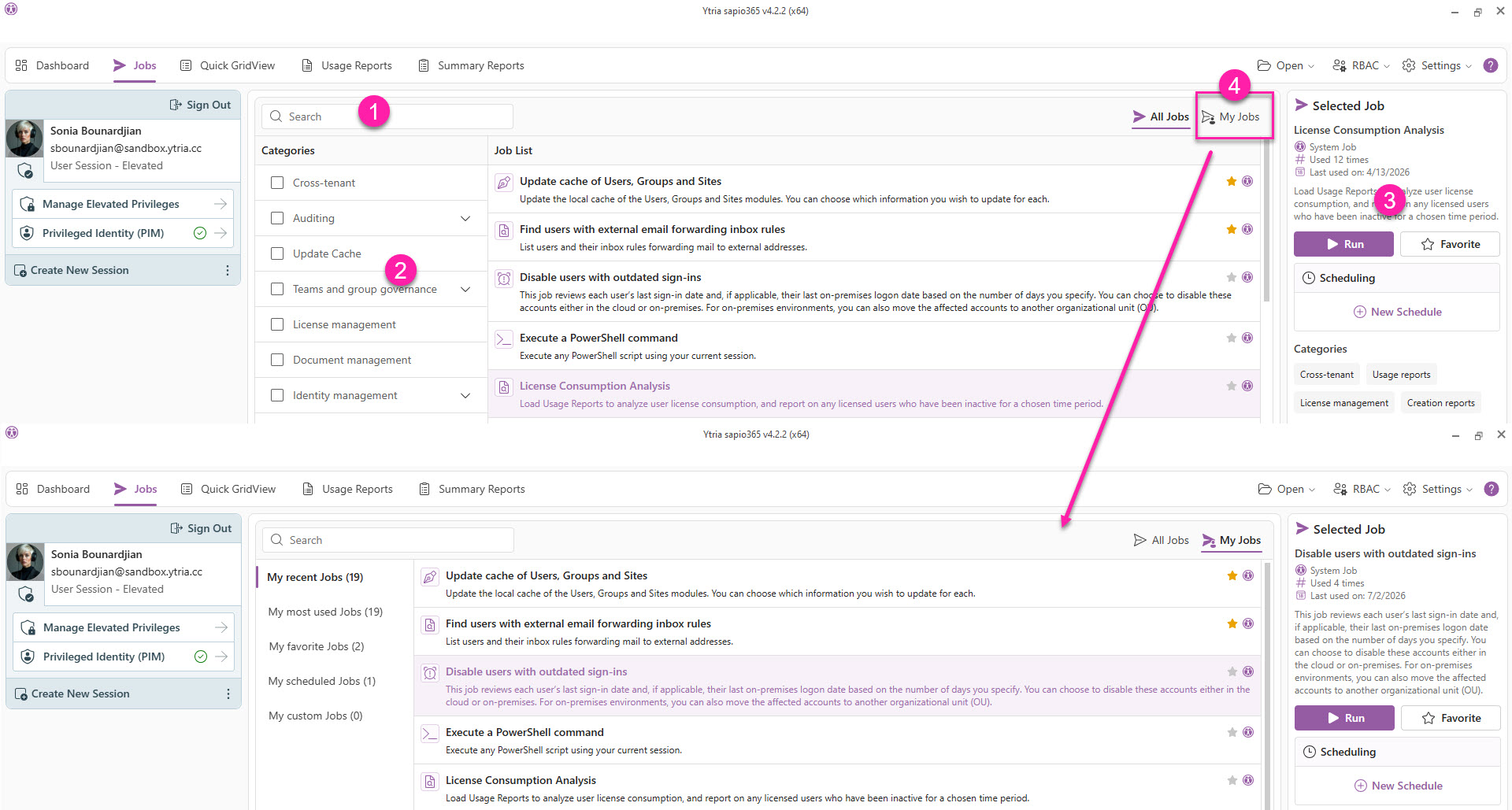
Jobs section explained
-
Type in the search box to find jobs by keyword.
-
Use the categories on the left to filter and isolate particular jobs. Unselect them all to restore all available jobs.
-
Select a job to see its description on the right before you execute it. From there, you can:
-
Run the job
-
Schedule it
-
Mark it as a favorite
-
-
Click My Jobs to see your favorited jobs at the top of the list, along with statistics about your job usage in the left-side panel.
Watch a short video on Jobs. (see top of page)