
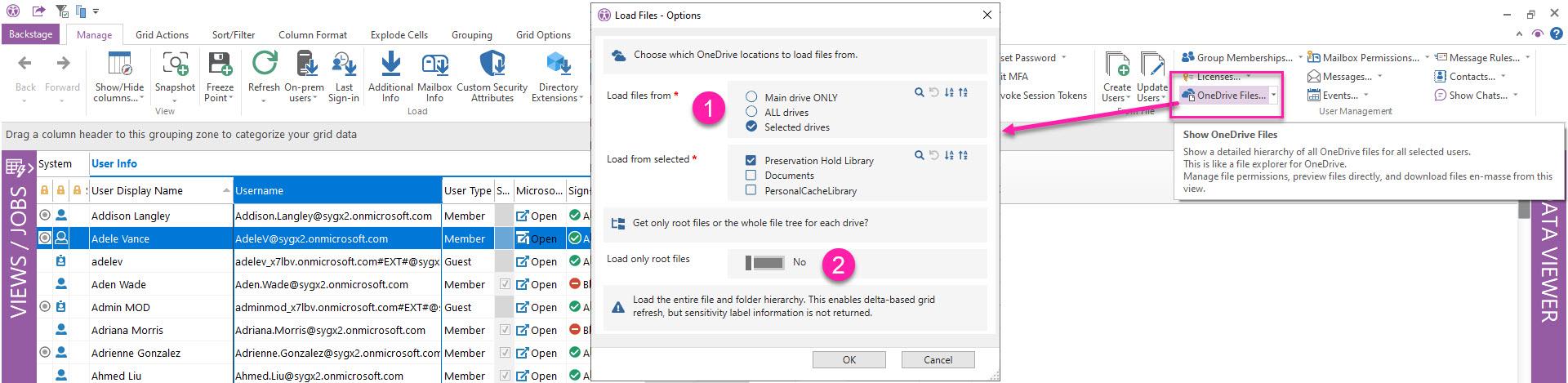
From the Users view, select one or more users, then click OneDrive Files to retrieve information about files and folders in their OneDrive.
Based on the loading options you select, the resulting OneDrive Files view displays either each user’s complete folder hierarchy, which you can expand or collapse, or only top-level files and folders. When you load top-level items only, you can retrieve additional information as you drill down into individual folders.
From this view, select files or folders to rename, download, or delete them from their respective OneDrive. You can also view applied retention labels, check out files, and manage sharing permissions.
See how to manage files and folders in sapio365.
Option 1 - Load from (the main drive, from all drives or from selected drives)
|
Load files from |
Description |
|---|---|
|
Main drive ONLY |
This is the default drive where files and folder are stored. |
|
All drives |
This includes the default drive, the Preservation Hold Library and any other libraries the user has created in OneDrive. |
|
Selected drives |
This option is only available when a single user is selected. Click to add a checkmark next to each drive that you want to load. |
Option 2 - Load only root files (or the entire file hierarchy)
|
Load only root files |
Description |
|---|---|
|
Yes |
Load only root-level files. This lets you drill down by loading deeper levels later but disables delta-based grid refresh. Sensitivity label information is available only with this option. After loading only root-level files, you can expand individual folders to load the next level of files and folders, or load the folder’s entire hierarchy. Get a quick size breakdown of drives and libraries Save time by loading only top-level information for each selected user’s default and additional drives or libraries. When used with Load from ALL drives, this option lets you quickly see how much storage each drive or library uses without loading its complete folder and file tree. |
|
No |
Load the entire file and folder hierarchy. This enables delta-based grid refresh, but sensitivity label information is not returned. Use with Freeze Points Loading the complete file and folder hierarchy is worthwhile when you need to work from a local cache. For example, if you monitor a specific OneDrive for new files or file-sharing permissions, save a Freeze Point and update it efficiently using the delta-based grid refresh. |