
Scheduled jobs in sapio365 rely on Windows Task Scheduler and, by default, require the user who created the schedule to remain logged in to Windows.
This page explains how to configure Windows Task Scheduler so sapio365 scheduled jobs can run even when no user is signed in to Windows.
This is especially useful in a sapio365 multi-user installation or when running sapio365 on a Microsoft Windows Server, where jobs need to continue running regardless of individual admin sessions.
Windows task scheduler setting
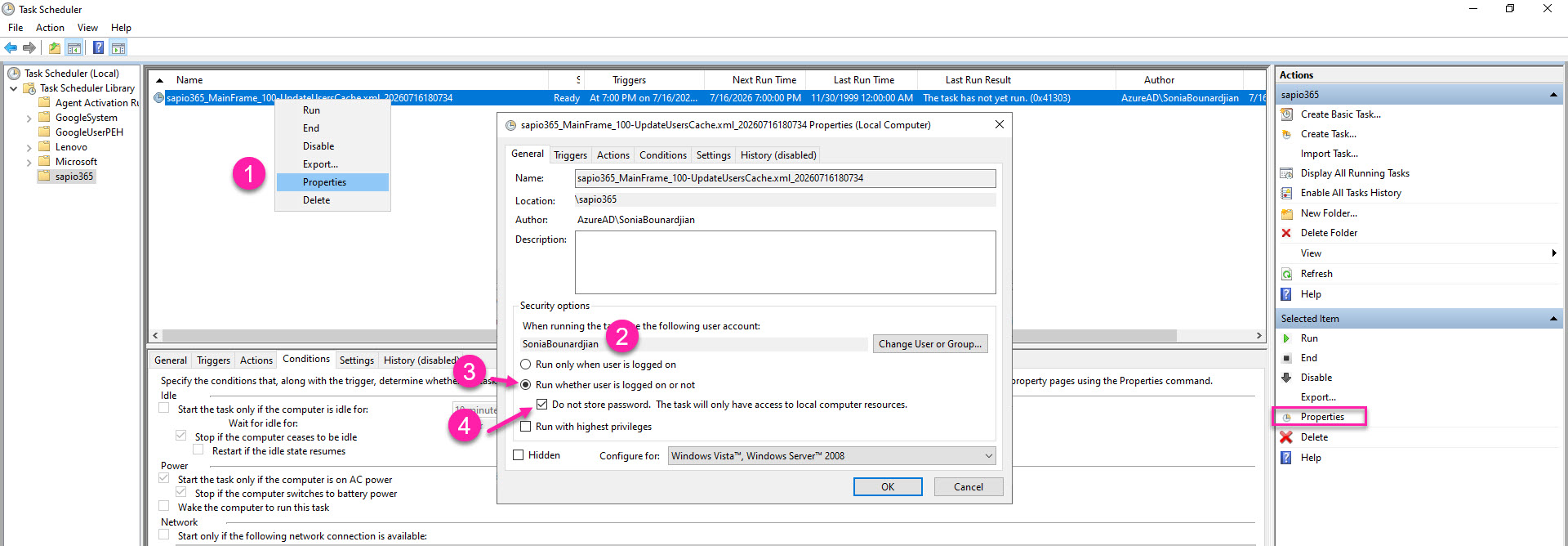
All scheduled sapio365 jobs are listed in the Windows Task Scheduler Library in the sapio365 folder.
-
Right-click the entry corresponding to the scheduled job and click Properties (or click in the panel on the right).
-
Ensure the Windows user account set for the task is able to run sapio365 on the machine.
-
Set the task to Run whether user is logged on or not.
-
Check Do not store password depending on your needs:
-
Option 1 – Leave unchecked if you want the task to run in the background with full access using the stored password.
-
Option 2 – Check it if you don’t want the password saved. Note that this will NOT work if the job needs access to resources like a Windows shared drive.
-
When “Do not store password” is enabled, the scheduled job may run without a full interactive logon session.
This can prevent access to network resources or other actions that require stored credentials, so use it only if the job has been confirmed to work in this mode.
Common error troubleshooting
When sapio365 scheduled jobs are configured to run via Windows Task Scheduler, you may encounter error codes in the task history (for example, error 2147943712). This type of error typically occurs when the system cannot store or use the credentials (especially the password) for the user account configured to run the scheduled task, and it can affect both client Windows and Microsoft Windows Server environments.
Common causes include but are not limited to:
-
Security policy restrictions – A local or domain Group Policy may prevent Windows from storing the credentials required to run the task.
-
Account configuration – The user account assigned to the task may be restricted from storing credentials for network authentication.
-
Task settings – The account configured for the task does not have permission to log on as a batch job, which is required for scheduled tasks to run under that account.
How to fix the error
-
Adjust the Local Security Policy
-
Open the Local Security Policy editor (
secpol.msc). -
Navigate to: Security Settings > Local Policies > Security Options.
-
Find the policy “Network access: Do not allow storage of passwords and credentials for network authentication” and set it to Disabled so Windows can store credentials for the task.
-
Apply the changes and run
gpupdate /force(or wait for Group Policy to refresh) so the new settings take effect.
Alternatively (advanced): change the registry
-
Open the Registry Editor (
regedit). -
Go to:
HKEY_LOCAL_MACHINE\System\CurrentControlSet\Control\Lsa. -
Find or create the
DisableDomainCreds(REG_DWORD) value and set it to 0 to allow credentials to be stored.
-
-
Review task and account configuration
-
Make sure the user account assigned to the task has a password and that the task is updated with the current password if you are storing it.
-
If you do not need the task to access network resources, you can enable the “Do not store password. The task will only have access to local computer resources” option in the task settings. Be aware this limits the task to local resources and is not suitable if it needs to reach shared drives or other network locations.
-
-
Grant “Log on as a batch job” rights
-
Open the Local Security Policy editor (
secpol.msc). -
Navigate to: Security Settings > Local Policies > User Rights Assignment.
-
Open “Log on as a batch job” and add the user (or service account) that runs the task.
-
Check “Deny log on as a batch job” to ensure the same account is not listed there, then save your changes.
-
Keep in mind:
-
If you are using a domain account, verify that domain Group Policies do not override your local settings or remove the batch logon right.
-
If the issue appears after a server reboot or Windows update, re-check these policies and task settings, because updates or GPO changes can revert security configuration and break previously working tasks.